

Jordanian Sprinter Aliya Boshnak Isn't Done Making Track History
She currently holds her country's national records for 100m, 200m, and 400m.
It's hard to find a Jordanian national record that Aliya Boshnak's name isn't attached to. The 25-year-old Olympic sprinter first made history representing her country on the track as the first Jordanian woman to qualify for the World Championships for juniors and girls in 2017, and she's been running ever since. She competed at the Tokyo Games in the women's 400m, and most recently added another record to her long list of national accolades by breaking yet another time barrier in late May. SceneSports caught up with the decorated sprinter to talk about where it all began, how she sees herself representing women in the sport, and what's next.
You started competing at just 11 years old. Was athletics always the plan?
Not at all. At 11, gymnastics was still my sport of choice. I ran a little with school and loved the adrenaline of competing, but if you'd asked me then, I never would have guessed athletics would become such a big part of my life.
Your family has Bosniak heritage — has that dual cultural identity shaped who you are as an athlete or as a person?
I'm not especially connected to my Bosniak heritage, although it's always been an interesting part of my identity and has led to some fun conversations when I'm in Europe. I'm more connected to my Palestinian side.
You hold national records in the 100m, 200m, and 400m. What does it mean to be the benchmark for sprinting in an entire country?
It's been incredibly rewarding. Each record represents a different chapter of my career and years of work behind the scenes. Hopefully there are still a few more left to break.
-359ddc8b-fde1-445a-941f-da2293c332b4.png) You were the first Jordanian woman to qualify for the World Junior Championships in 2017. What do you remember about that moment — and did you fully grasp how significant it was?
You were the first Jordanian woman to qualify for the World Junior Championships in 2017. What do you remember about that moment — and did you fully grasp how significant it was?
What I remember most is relief. When it finally happened, my first thought was: Okay, we did it. The significance only really sank in afterward. It also made it even more special that another Jordanian athlete, Sharif, qualified that year too — so we got to share that experience together.
You won two gold medals at the Arab Women's Championships in the 200m and 400m. How did those victories shift your confidence and your ambitions?
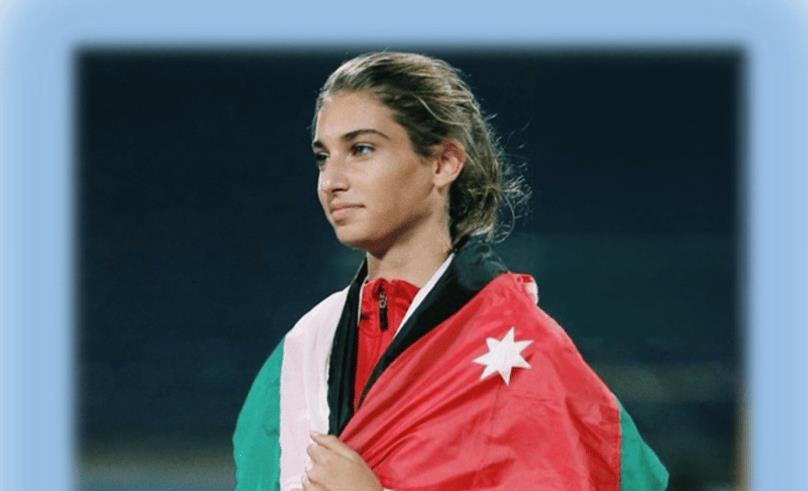
It gave me confidence. I still remember standing there with the Jordanian flag around my shoulders and seeing my friends and family in the stands. Those are the moments you carry with you.
Competing at the Tokyo Olympics was a landmark moment — not just for you personally, but for Jordanian athletics. What was going through your mind?
I was incredibly excited, but there was also a strange sense of calm. I remember having a quiet moment to myself and thinking: I'm really here.
The 2020-21 season was essentially erased by the pandemic — and yet you competed at the Olympics on the other side of it. How did you stay sharp and motivated through all of that?
One lesson sport has taught me is that you can only control what you can control. During COVID, there was so much uncertainty that worrying about things outside my control felt pointless. In Amman, I trained wherever I could — on the streets, on hills around my house, and eventually around the forest area at Sports City. As for the Olympics, for a while we genuinely didn't know if Tokyo would happen, but I decided I had nothing to lose by preparing as though it would. I found races in Poland, did time trials when necessary, and tried to stay ready despite all the uncertainty. Life was more normal than people might expect — I was doing an internship at the time, so my days revolved around work, training, and seeing friends. Once my selection became official, I had to tell my manager I'd be leaving early — which is probably one of the few acceptable reasons to cut an internship short.
You competed collegiately at Yale while simultaneously representing Jordan internationally. Looking back, how did you manage the demands of both?
I'm not entirely sure how I thought that schedule was normal. International seasons would stretch into August, and then university competition would start again in December. It made for a very long year, but I loved both environments and didn't want to choose between them. It probably helped that I was young and my body bounced back fast.
Now that your collegiate career is behind you, what does the next chapter look like?
I'm still focused on representing Jordan, but I've always been someone with interests beyond the track. I've always cared deeply about academics, my career, and creative pursuits. After working in strategy consulting at McKinsey, I transitioned into the sports industry itself. Athletics is a huge part of who I am — but it's never been the only part.
What would it take, in your view, for Jordan to build a genuine pipeline of world-level track and field athletes?
Stronger youth systems, stronger clubs, and a more consistent competition pathway. We have talented athletes. The challenge is creating an environment where they can develop and compete consistently.
-04eb0ad5-071b-4661-b447-3639e329fa9b.png) What does success look like for you over the next four years — and is another Olympics on the horizon?
What does success look like for you over the next four years — and is another Olympics on the horizon?
Success looks like challenging myself every day, trusting my preparation, enjoying the process, and continuing to pursue ambitious goals. Of course I'd love to represent Jordan on the Olympic stage again — but success has become about much more than results alone.
When you're alone on the track before a big race, what emotions run through you — and has that feeling changed from when you were a teenage girl racing for Jordan the first time?
It's definitely changed. When I was younger, racing was pure excitement. Now there are always a few nerves during the warm-up, but once I settle into the blocks there's a sense of calm that comes from experience. I'd love to bring a little more of that youthful excitement back into my racing.
Have there been moments where the weight of representing your country felt like too much?
No, not really. Representing Jordan has always felt like a privilege. There's nothing quite like wearing the national kit, hearing the anthem, and knowing you're competing for something bigger than yourself. Despite the challenges that can come with representing a smaller federation, I wouldn't change it.
Is there someone without whom none of this would have happened?
My mom, without question. She always believed in me and supported me completely. What makes that support so meaningful is that it was never tied to performance. If I decided tomorrow that I never wanted to run another race, she'd support that too.
How would you describe yourself to someone who's never heard of Aliya Boshnak — and what do you want people to say about you when your career is over?
Excited. And I hope they remember that I was a fighter — and that I genuinely loved to race.
What surprises people most when they meet you for the first time?
How much of my life exists outside athletics. I've always loved academics, art, travel, and building a career alongside competition. I'm also much goofier than people expect — the serious version of me people see on race day is only one side of my personality.
- Previous Article Were Morocco’s National Anthem Lyrics Created for the World Cup?
- Next Article The Clubs Driving the MENA Region’s Padel Obsession
Related Articles
Trending This Month
-
 Oct 04, 2026
 -
-
 Oct 05, 2026
 -