

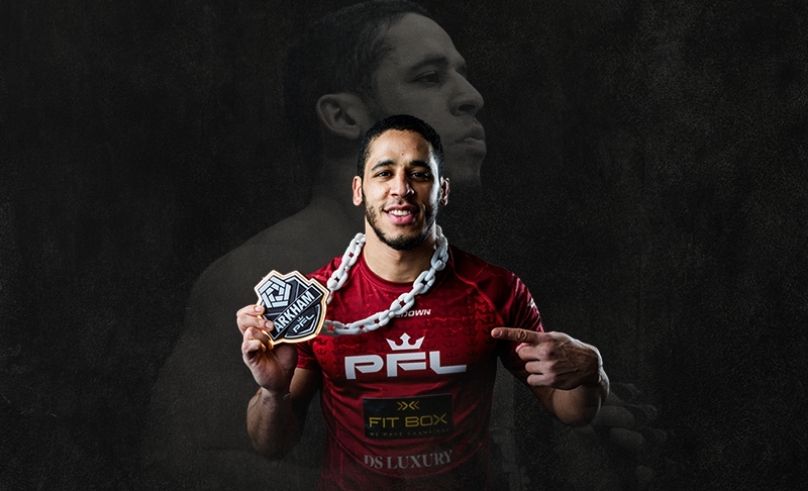
Omar El-Dafrawy Turned Setbacks Into a PFL MENA Title Run
Omar El-Dafrawy built his MMA career through late beginnings, perseverance and a PFL MENA championship run.
Long before Omar El-Dafrawy became one of Egypt’s clearest paths into elite international mixed martial arts, before championship belts, ranking 6th globally and world-title conversations, he was a hyperactive kid moving across countries with a restless energy his family believed was destined for something bigger.
Born to Egyptian parents and raised largely in Saudi Arabia while travelling internationally because of his father’s work, El-Dafrawy’s childhood was shaped by movement long before fighting ever entered the picture. There were no childhood wrestling rooms, no polished amateur pipeline, no early blueprint pointing toward professional combat sports. But even then, there were signs.
“When I was young, I was very hyperactive kid, running around, punching anything, maybe it was always there inside of me,” El-Dafrawy said. As a child, he was constantly in motion, running, crashing, testing limits.
That energy first found discipline in 2013, when El-Dafrawy began physical training at 18. Before fists, cages and title fights, there was calisthenics. Through bodyweight training, structure and obsession, he built not only his physique but his first real identity, eventually running his own calisthenics gym out of his backyard.
Before he became a fighter, El-Dafrawy was already building something. At the time, fighting lived at a distance. He was a fan, watching from the outside, studying champions and imagining possibilities. Then, at 21, an age when many elite fighters are already years into their careers, something clicked.
“I was watching Jon Jones, Conor McGregor. In 2016, there was a movie called Southpaw that I watched, and the story inspired me so much,” he recalled. The film 'Southpaw' helped shape Omar El-Dafrawy’s fighting identity, inspiring both his mindset and his style. He naturally adopted a southpaw stance himself, which has since become a core part of his striking and a key weapon in his MMA game.
Six months after beginning training, he took his first fight. The date happened to fall on the day Muhammad Ali died. For El-Dafrawy, it felt symbolic. “I fought my first fight six months after my debut," he said. "The day I fought was the same day Muhammad Ali passed away. I thought to myself: He’s gone. I’m coming.”-95c186ee-7bee-4561-a521-1482cf754818.jpg) El-Dafrawy rose quickly through Egypt’s regional scene, erupting as a promising welterweight and eventually becoming Egyptian champion in 2021. But local success was never the destination. Egypt was the start, not the finish line. El-Dafrawy’s vision was always international, toward MMA’s highest stages, from the Professional Fighters League (PFL) to hopefully the Ultimate Fighting Championship (UFC), widely considered the sport’s pinnacle, to other elite global promotions.
El-Dafrawy rose quickly through Egypt’s regional scene, erupting as a promising welterweight and eventually becoming Egyptian champion in 2021. But local success was never the destination. Egypt was the start, not the finish line. El-Dafrawy’s vision was always international, toward MMA’s highest stages, from the Professional Fighters League (PFL) to hopefully the Ultimate Fighting Championship (UFC), widely considered the sport’s pinnacle, to other elite global promotions.
To chase that future, he understood he would have to destroy the stability he had already built. He shut down his calisthenics gym. He left behind income, security and ownership. Then he boarded a one-way flight to Bali with almost nothing. “I lost my gym. I had to shut it down to chase my passion. I travelled with a one-way ticket to Bali with $300 in my bank account. I had nothing. I owned nothing, and I had to fight every two months just to cover my expenses.”
It was not a glamorous leap. It was survival. Bali became less of a destination than a proving ground, a place where El-Dafrawy lived fight to fight, camp to camp, paycheck to paycheck. Every two months meant another bout, another purse, another chance to stay afloat. Before that, he had also partially relocated to Thailand in 2017, sharpening his tools in a deeper fight culture and learning the brutal rhythms of international competition.
This was no longer about hype. It was about sharpening his stand-up, surviving weight cuts, improving cage IQ and learning what it actually cost to chase world-level fighting. And the cost was high.
The transition from national champion to international contender was punishing. Harder opponents. Tougher losses. Gruelling sacrifices just to make weight. Momentum repeatedly interrupted. Then came mandatory Egyptian military service following graduation, forcing his career into an abrupt halt just as he was trying to break through.-937a4a9b-9697-4c0d-bc5c-da4c117d6188.jpg) Outside the cage, public scrutiny compounded the damage. “People went from not knowing who I was to labelling me a title loser with no heart,” El-Dafrawy recalled. He went from being an unknown fighter in the region to facing harsh public criticism, with his losses and personal circumstances quickly becoming the subject of online backlash and doubt about his future in the sport.
Outside the cage, public scrutiny compounded the damage. “People went from not knowing who I was to labelling me a title loser with no heart,” El-Dafrawy recalled. He went from being an unknown fighter in the region to facing harsh public criticism, with his losses and personal circumstances quickly becoming the subject of online backlash and doubt about his future in the sport.
After repeated setbacks, he returned from Bali mentally exhausted and ready to walk away from the sport entirely. “I went to Islamic scholars. I wanted anyone to tell me that fighting was not allowed in the religion. I was searching for any excuse to retire.” The same man who once shut down his business and boarded a one-way ticket for his dream was now searching for a reason to stop dreaming altogether.
Then came a moment he interpreted as fate: a US visa approval he had filed for almost casually, just in case. Instead of an exit, it became a turning point.
“That's a sign, we're going back to Bali. My first fight back, I won by decision. I fought to the very last breath, but this time I won.”
That win became the first step in rebuilding everything. El-Dafrawy began stacking victories again, clawing his way back from the edge of retirement and eventually earning a place in the Professional Fighters League (PFL), one of MMA’s premier global organizations. Through PFL MENA, the league’s regional platform for Middle Eastern and North African fighters, he entered the inaugural welterweight tournament with a second life.
“During PFL MENA I fought the greatest of all time, Arabian fighter. I knocked him out in the first round, and advanced. I qualified to the final, and in the final, I knocked out the last guy that beat me in March 2023, the last fight that I lost before I wanted to retire!”
The fighter who had once searched for excuses to quit became the inaugural PFL MENA welterweight champion in 2024 by defeating the very shadow that nearly ended him. That is what defines Omar El-Dafrawy now, not simply knockout power or rankings, but reinvention. “The thing is, people thought I was going to break. Some people don't know who they are because they're too surrounded by others. They haven't really found their full potential. They don't know what they can do.”
His career is still active, his title ambitions still growing, but his vision has expanded beyond himself. Through FitBox, where he evolved from client to owner, El-Dafrawy is trying to build opportunities for younger Egyptian fighters who may face the same missing infrastructure he once did. “I care to give young Egyptian fighters the opportunities I didn’t have growing up”. -0b6caa0e-f7c9-487e-b7a5-78f8105c0358.jpg) His youngest brother, Youssef El-Dafrawy, may represent that next wave most personally. “He’s going to be something scary,” El-Dafrawy said, following in his footsteps on a university boxing scholarship.
His youngest brother, Youssef El-Dafrawy, may represent that next wave most personally. “He’s going to be something scary,” El-Dafrawy said, following in his footsteps on a university boxing scholarship.
Now, with a major win in Chicago in April 2026 and a place among the top six welterweights in the PFL, El-Dafrawy no longer speaks like a man trying to prove he belongs. He sounds like a fighter closing in on the belt.
“I couldn't see the PFL title when I was still in PFL MENA. Now I'm top six in my weight class, there are only six guys above me. I don't need to beat all six, I'm coming for that title!”
For Omar El-Dafrawy, the journey has never followed a conventional script. Then he rebuilt himself into one of Egypt’s most compelling fighting stories. Before titles, before rankings, before global recognition, there was simply a man willing to bet everything on the possibility that he could become something great.
- Previous Article Wady Le3b Hopes to Transform Amateur Football With Spot-based Booking
- Next Article Ahmed Abdo: The Cup Alexandria Never Let Go
Related Articles

Trending This Month
-
 Oct 04, 2026
 -
-
 Oct 05, 2026
 -