

Karam Gaber Dominated on the Mat From Start to Finish
The gold-winning Egyptian Olympian was a force in the Greco-Roman wrestling world.
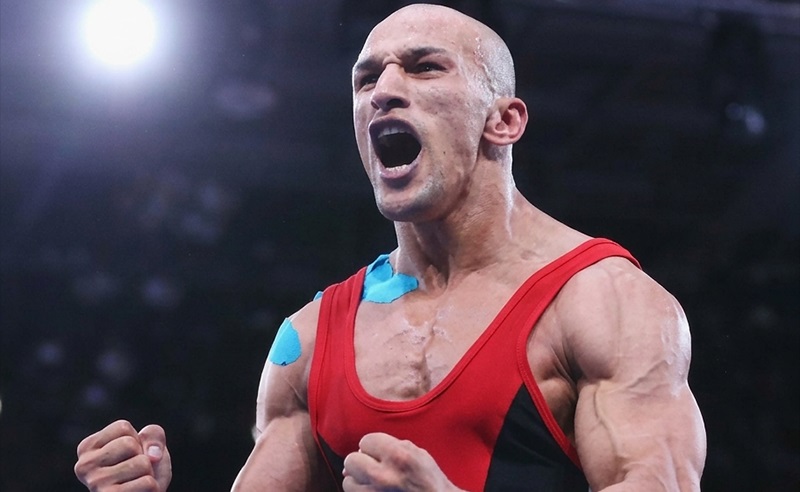
Karam Gaber first rose to prominence nearly 22 years ago, when he captured gold at the 2004 Athens Olympics in Greco-Roman wrestling. But long before that breakthrough, the wrestler, nicknamed' El-Harif', had been quietly building his legacy. It was a journey that began in 1997, when he was an unstoppable burst of energy on the mat.
In 1997 alone, Gaber collected four medals despite still competing at the junior level. He opened the year with an African gold in Morocco and followed it with another gold at the Arab Games in Lebanon. He then added bronze at the Mediterranean Games in Italy and closed the year with bronze at the World Junior Championships in Finland.
-c3b7d807-ab4e-4076-9c7d-de77562c07e3.png)
He carried that momentum into 1998, winning African gold again, and adding a second world junior bronze in Cairo. By the turn of the century, in 1999 and 2000, he had the continent in a chokehold, claiming two more gold medals, one at the All-Africa Games in South Africa and the other at the African Championships in Tunisia.
Sydney 2000
One of Gaber’s defining early moments, which he later recounted on the 'Conversations with Abbas' podcast with host Abbas Abu ElHussein, came during the Ibrahim Moustafa International Championship in Alexandria — a qualifier for the Sydney 2000 Olympics. There, he faced an Israeli opponent.
“I played an Israeli for the first time, in Alexandria, and he was the world champion,” Gaber said “I lost the first match 3–0. I felt things were slipping and it became about pride. Thank God, I came back and won 10–3 and qualified.”
Drama in El-Harif’s Life
Two months before the Sydney Olympics, Gaber suffered a broken foot during a training camp in Russia, an incident he said was a mental setback after the joy of qualifiying. The injury forced him to stay at home for months, and, at one point, pushed him into considering quitting. Instead, he persevered. After three months, Gaber recovered, started running, training and returned to the national team.
-50048de1-c9d2-484b-9737-3d7af0f1b1dd.png)
Facing the Seniors
In 2001, Gaber competed in his first senior World Championships in Greece. He was eliminated early — but learned a crucial lesson.
“I learned that a world champion has to stay in control the entire match,” he said on the podcast. “It’s not about winning one or two bouts and scaring people. My style was to finish matches in one move — that’s junior wrestling. At the senior level, it’s completely different. You have to be careful.”
Grind and Growth
After the setback in Greece, Gaber entered a new phase of maturity, beginning with gold at the Mediterranean Games in Tunisia. In 2002 and 2003, he moved closer to the world throne, winning two silver medals at the World Championships in France and Moscow, along with three continental golds across African and All-Africa competitions.
“I kept grinding to reach finals, but mentally I focused only on getting there — not on winning gold," Gaber recalled on the podcast. "It’s like I celebrated too early. The lesson I learned was to hold your power until the moment you win gold. If you celebrate before that, it’s over.”
And when Athens 2004 arrived, Gaber didn’t just win gold — he dominated. The tournament made him famous for his signature “big lift,” hoisting opponents weighing nearly 100kg high into the air before slamming them onto the mat. He followed that golden era with another Mediterranean Games gold in Spain in 2005.
After Gold
Gaber’s life changed dramatically after Olympic gold. He has claimed that wrestling participation in Egypt increased by around 40%, adding that is recognised abroad more than in his own home country.
Another Turning Point
Ahead of Beijing 2008, the king of the sport faced setbacks again — losing at the 2006 World Championships and missing 2007 entirely. Although he qualified for the Olympics by winning gold in Serbia, he exited in the preliminary rounds.
The Champion Returns
After years away, Gaber defied time and returned to the mat. In 2011 he won Arab Championship gold in Qatar and African Championship gold, qualifying for the London 2012 Olympics.
At 33 years old, and at a lighter weight of 84kg, he shocked the world again — reaching the Olympic final and winning silver at London 2012, proving that talent doesn’t age.
A Childhood Dream
After London 2012, Gaber stepped away from Greco-Roman wrestling, but his childhood dream — winning three Olympic medals — never left him. An administrative error prevented him from competing at Rio 2016, a blow that pushed him into frustration.
El-Harif Doesn’t Age
From 2015 to 2023, Gaber stepped away from competition and explored acting before deciding to retire. But in 2023, after turning 40, he surprised everyone — winning Masters World gold in Greece. In 2024, he followed it with bronze at the Masters World Championships in Croatia.
-43cf4115-6568-4680-87e3-6a9c65485972.png)
Things You Didn’t Know About Gaber
During his career, Gaber rejected offers to change nationality from the United States, France and Qatar.
Life After Retirement
Gaber plans to launch a tournament bearing his name, inspired by great champions, organised in a new format. He also aims to produce a film telling the story of his decorated career, while deepening his interest in astronomy.