

Why Robot Jockeys Have the Reins in Camel Racing
In the Gulf, camel racing is one of the region's oldest sporting traditions, yet it now employs one of the most innovative technologies in the sports industry; robot jockeys.

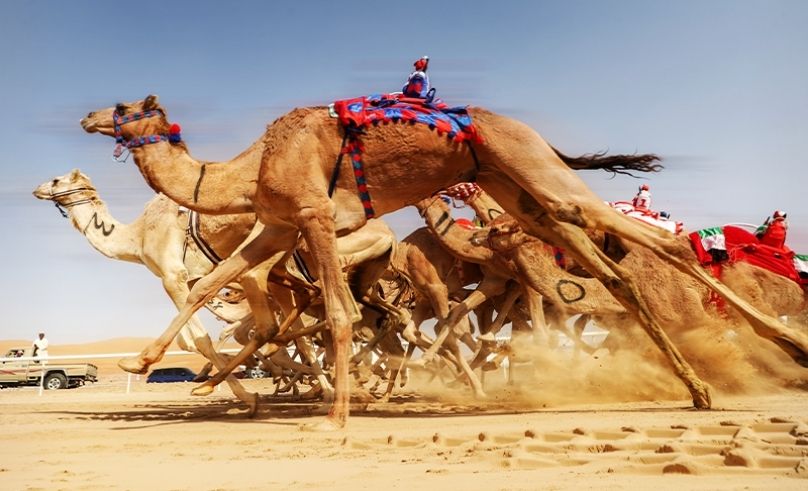
Across the desert racetracks of the Gulf, camels thunder forward at speeds of up to 65 kilometres per hour, their long legs kicking up clouds of sand. You won't find any human riders on their back - rather, they are being driven by robot jockeys. In one of the world’s oldest sports, technology has quietly taken the reins.
These robot jockeys are lightweight humanoid devices, made to guide the camels during races. The robot jockey’s design is deliberate; most are shaped loosely in human form, not for aesthetics, but for function. Their human-like frame helps camels adapt more comfortably to their presence. Each carries a whip, a harness securing it to the camel’s back, and a speaker system through which trainers issue commands from afar.-33da0118-77db-430e-8a73-348ddbcc0cbc.jpg) As races unfold, trainers drive SUVs alongside the track, remotely controlling the robot while monitoring the camel’s speed, heart rate, and location through GPS and biometric systems. In practical terms, the robot is both rider and racing instrument, designed not only to guide but also to analyse.
As races unfold, trainers drive SUVs alongside the track, remotely controlling the robot while monitoring the camel’s speed, heart rate, and location through GPS and biometric systems. In practical terms, the robot is both rider and racing instrument, designed not only to guide but also to analyse.
Camel racing itself dates back to Bedouin life in the 14th century, though it became formally organised in 1964 under King Faisal bin Abdulaziz. Today, the sport has grown into a massive industry. Events such as the King Abdulaziz Camel Festival feature around 38,000 registered camels and offer prize funds reaching hundreds of millions of Saudi riyals, making it one of the richest camel racing competitions in the world.-477ca705-bf1a-483b-8172-e82fa6a441ce.jpg) The rise of robot jockeys was driven less by innovation than by necessity. Before their introduction, child jockeys were commonly used in Gulf camel racing because of their small stature and low weight. Many of these children, often brought from poorer countries, faced kidnapping, exploitation and abuse. The UAE formally banned child jockeys in 2004, followed by Qatar in 2005 and other Gulf nations soon after. Robot jockeys emerged not just as a technological solution, but as a humanitarian one.
The rise of robot jockeys was driven less by innovation than by necessity. Before their introduction, child jockeys were commonly used in Gulf camel racing because of their small stature and low weight. Many of these children, often brought from poorer countries, faced kidnapping, exploitation and abuse. The UAE formally banned child jockeys in 2004, followed by Qatar in 2005 and other Gulf nations soon after. Robot jockeys emerged not just as a technological solution, but as a humanitarian one.
Though they may seem futuristic, robot jockeys are not a recent invention. For the past two decades, robot jockeys have become the standard in camel racing, a billion-dirham industry deeply rooted in Gulf culture. Their development began in the early 2000s, with Qatar launching early projects in 2001. By 2003, Swiss robotics company K-Team had produced one of the first successful models under Qatari ownership. The UAE later refined the technology, creating lighter and more efficient versions, which debuted in a major public trial at AlWathba in 2005. -41241977-8151-4480-86b3-ce1a8eb4478f.jpg) In financial terms, the robot itself is one of the least expensive parts of the sport. According to UAE manufacturer Bait Al Thiqa, a robot jockey costs between AED 1,000 and AED 2,000, while elite racing camels can cost up to AED 1 million.
In financial terms, the robot itself is one of the least expensive parts of the sport. According to UAE manufacturer Bait Al Thiqa, a robot jockey costs between AED 1,000 and AED 2,000, while elite racing camels can cost up to AED 1 million.
Robot jockeys represent a rare balance between preserving tradition and embracing progress. They removed one of camel racing’s darkest practices while improving safety and even performance through lighter, more efficient design. As Gulf nations continue to invest in camel racing through tourism and national development plans such as Saudi Vision 2030, these tiny mechanical riders stand as symbols of how even the oldest traditions can evolve without losing their identity. In camel racing today, the future rides on the back of the past.