

Citizens & Stadiums: The Decades-Long History of Cricket in the UAE
In 1984, the first official One-Day International was played at the Sharjah Cricket Stadium.

When Khuzaima Tanveer, Ajay Kumar, Akshdeep Nath, Harpreet Singh Bhatia and Adeeb Usman, became the first cricket players to be granted UAE citizenship through naturalisation in April 2026, the moment marked another milestone in the country’s long history with the sport. It was a game that arrived in the hands of migrant workers, played on sandy plots after long shifts, and has now produced citizens. To understand how that moment came to be, you have to go back to the beginning.
Sandy Pitches & a Long Way From Home
-78b20cd8-a89d-488b-908d-ad2219a8bf3a.jpg) Cricket arrived in the United Arab Emirates through South Asian labourers. Men who crossed the Gulf for work carried their love of the game with them, found one another on dusty plots of land, bat and ball in tow, and began playing informal matches after long shifts in a foreign country. These matches were as much about sport as they were about belonging. That was the quiet, unplanned beginning of what would become one of the most unlikely stories in the history of cricket.
Sharjah & the Man Who Started It All
Cricket arrived in the United Arab Emirates through South Asian labourers. Men who crossed the Gulf for work carried their love of the game with them, found one another on dusty plots of land, bat and ball in tow, and began playing informal matches after long shifts in a foreign country. These matches were as much about sport as they were about belonging. That was the quiet, unplanned beginning of what would become one of the most unlikely stories in the history of cricket.
Sharjah & the Man Who Started It All
-dbbe1048-caef-465d-a241-9142822aeefa.jpg) The moment cricket found its first formal footing in the UAE came in 1981, when Abdul Rahman Bukhatir, an Emirati businessman and media entrepreneur, conceived of the Cricketers Benefit Fund Series following an exhibition match in Sharjah. It was a modest but decisive start. Three years later, in 1984, the first official One-Day International was played on that same ground — Sri Lanka against Pakistan — and Sharjah Cricket Stadium began its slow ascent into the sport's consciousness.
What followed was a decade of moments that etched the venue into cricketing folklore. In 1986, Pakistani batsman Javed Miandad hit a last-ball six off India's Chetan Sharma to clinch a dramatic victory — a moment replayed endlessly across the subcontinent for years. Then came 1998, and Sachin Tendulkar's back-to-back centuries against Australia in the final stages of a tournament, innings so dominant it was immediately christened the Desert Storm. For a stadium in the middle of the desert, Sharjah was producing the kind of theatre that Lords and Eden Gardens could only admire.
Off the pitch, the sport's administrative foundations in the country were also taking shape. The Emirates Cricket Board was established in 1989, and the UAE earned Associate Member status with the International Cricket Council the following year, qualifying for their first Cricket World Cup in 1996.
A Global Nerve Centre
The moment cricket found its first formal footing in the UAE came in 1981, when Abdul Rahman Bukhatir, an Emirati businessman and media entrepreneur, conceived of the Cricketers Benefit Fund Series following an exhibition match in Sharjah. It was a modest but decisive start. Three years later, in 1984, the first official One-Day International was played on that same ground — Sri Lanka against Pakistan — and Sharjah Cricket Stadium began its slow ascent into the sport's consciousness.
What followed was a decade of moments that etched the venue into cricketing folklore. In 1986, Pakistani batsman Javed Miandad hit a last-ball six off India's Chetan Sharma to clinch a dramatic victory — a moment replayed endlessly across the subcontinent for years. Then came 1998, and Sachin Tendulkar's back-to-back centuries against Australia in the final stages of a tournament, innings so dominant it was immediately christened the Desert Storm. For a stadium in the middle of the desert, Sharjah was producing the kind of theatre that Lords and Eden Gardens could only admire.
Off the pitch, the sport's administrative foundations in the country were also taking shape. The Emirates Cricket Board was established in 1989, and the UAE earned Associate Member status with the International Cricket Council the following year, qualifying for their first Cricket World Cup in 1996.
A Global Nerve Centre
-349a646d-a834-4a97-b25d-aeecf064ff14.jpg) The most structurally significant moment in the UAE cricket's evolution came from a relocation. In 2005, the ICC moved its global headquarters from London to Dubai, a decision that reframed the UAE's role in the sport entirely. The country was now the administrative centre of world cricket and not simply a host.
The timing coincided with a rapid expansion of infrastructure. The Zayed Cricket Stadium in Abu Dhabi opened in 2006, followed by Dubai International Stadium in 2009. Three international-grade venues in one country gave the UAE a capacity that few others could match, and the offers soon followed. By the time Sharjah Cricket Stadium had hosted 263 ODIs — a world record — the UAE's place in the sport's landscape had long been secured.
Cricket's Most Reliable Backup
The most structurally significant moment in the UAE cricket's evolution came from a relocation. In 2005, the ICC moved its global headquarters from London to Dubai, a decision that reframed the UAE's role in the sport entirely. The country was now the administrative centre of world cricket and not simply a host.
The timing coincided with a rapid expansion of infrastructure. The Zayed Cricket Stadium in Abu Dhabi opened in 2006, followed by Dubai International Stadium in 2009. Three international-grade venues in one country gave the UAE a capacity that few others could match, and the offers soon followed. By the time Sharjah Cricket Stadium had hosted 263 ODIs — a world record — the UAE's place in the sport's landscape had long been secured.
Cricket's Most Reliable Backup
-5bb57dd9-bac1-49d6-bb04-af04607862e3.jpg) What distinguished the UAE from other hosting nations was its flexibility. When Pakistan was unable to host international cricket following security concerns in 2009, the UAE stepped in and became Pakistan's de facto home ground for years, hosting Test series, ODIs and T20 Internationals across all three venues.
The same pattern repeated itself with India's Premier League. In 2014, a scheduling conflict with Indian parliamentary elections forced the IPL to relocate a portion of its season to the UAE. Six years later, when the COVID-19 pandemic brought international sport to a standstill, the IPL staged its entire 2020 season within the UAE's biosecure bubbles. When the pandemic interrupted the 2021 edition mid-way through, the remaining matches were completed in Abu Dhabi, Dubai and Sharjah once again.
That consistency established the UAE's defining identity in world cricket as the sport's most dependable alternative. Subhan Ahmed, COO of the Emirates Cricket Board, acknowledged the point directly, describing flexibility as the country's unique selling point. It was an honest summary of a role the UAE had earned through repetition rather than proclamation.
The tournament hosting rights that followed reflected that trust. The T20 World Cup was staged across the UAE's three venues in 2021. The Women's T20 World Cup arrived in 2024, having been relocated from Bangladesh. The Asia Cup has been held in the country three times — in 2018, 2022 and 2025.
The Team Behind the Tournaments
What distinguished the UAE from other hosting nations was its flexibility. When Pakistan was unable to host international cricket following security concerns in 2009, the UAE stepped in and became Pakistan's de facto home ground for years, hosting Test series, ODIs and T20 Internationals across all three venues.
The same pattern repeated itself with India's Premier League. In 2014, a scheduling conflict with Indian parliamentary elections forced the IPL to relocate a portion of its season to the UAE. Six years later, when the COVID-19 pandemic brought international sport to a standstill, the IPL staged its entire 2020 season within the UAE's biosecure bubbles. When the pandemic interrupted the 2021 edition mid-way through, the remaining matches were completed in Abu Dhabi, Dubai and Sharjah once again.
That consistency established the UAE's defining identity in world cricket as the sport's most dependable alternative. Subhan Ahmed, COO of the Emirates Cricket Board, acknowledged the point directly, describing flexibility as the country's unique selling point. It was an honest summary of a role the UAE had earned through repetition rather than proclamation.
The tournament hosting rights that followed reflected that trust. The T20 World Cup was staged across the UAE's three venues in 2021. The Women's T20 World Cup arrived in 2024, having been relocated from Bangladesh. The Asia Cup has been held in the country three times — in 2018, 2022 and 2025.
The Team Behind the Tournaments
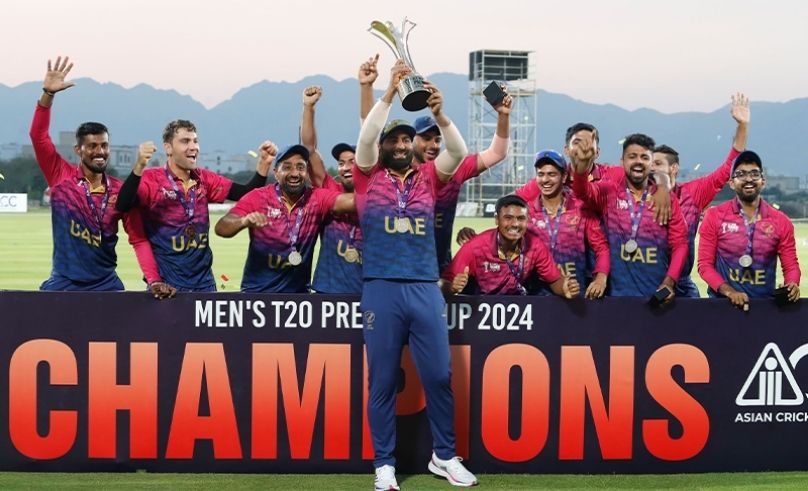
-39be92a9-62c8-4061-8481-025746a4d507.jpg) While the UAE built its reputation as a global cricket hub through infrastructure and administrative moves, its national team has been carving out its own, quieter story. A squad made up of expatriate players and Emirati-born talent has qualified for multiple editions of the World Cup, including the 1996 and 2015 editions, and has featured across Asia Cups and T20 qualifying campaigns.
The gap between the UAE as a host nation and the UAE as a competitive cricket nation remains wide. Head coach Lalchand Rajput acknowledged as much during the 2025 Asia Cup, framing fixtures against India and Pakistan less as contests to win and more as benchmarks — opportunities for the country's players to measure themselves against the very best. Grassroots programmes are in development to bring more Emirati players into the system, with the women's team also making inroads at the qualifying level. The ambition is long-term. The infrastructure, by any measure, is already there.
A Desert, Three Stadiums & the World's Game
While the UAE built its reputation as a global cricket hub through infrastructure and administrative moves, its national team has been carving out its own, quieter story. A squad made up of expatriate players and Emirati-born talent has qualified for multiple editions of the World Cup, including the 1996 and 2015 editions, and has featured across Asia Cups and T20 qualifying campaigns.
The gap between the UAE as a host nation and the UAE as a competitive cricket nation remains wide. Head coach Lalchand Rajput acknowledged as much during the 2025 Asia Cup, framing fixtures against India and Pakistan less as contests to win and more as benchmarks — opportunities for the country's players to measure themselves against the very best. Grassroots programmes are in development to bring more Emirati players into the system, with the women's team also making inroads at the qualifying level. The ambition is long-term. The infrastructure, by any measure, is already there.
A Desert, Three Stadiums & the World's Game
-3f054db6-1df6-4104-b1c4-70af52d1ea29.jpg) Each of the UAE's three venues carries its own character. Sharjah, the oldest and smallest, built its legend on short boundaries and high scores. Abu Dhabi's Zayed Cricket Stadium, with its expansive outfield and spectators seated on grass mounds along the boundary, rewards patience. Dubai International Stadium is an amphitheatre, its ring-of-fire lighting system casting no shadows on a ground that has become a regular stage for the sport's biggest occasions.
They were built to host the world. In the decades since that first exhibition match on a Sharjah ground in 1981, they have done exactly that. They were built to host the world. In the decades since that first exhibition match on a Sharjah ground in 1981, they have done exactly that. And then, in 2025, five cricketers — Khuzaima Tanveer, Ajay Kumar, Akshdeep Nath, Harpreet Singh Bhatia and Adeeb Usmani — became the first to be granted UAE citizenship through naturalisation. A game brought over by migrant workers, played on dusty plots after long shifts, had finally produced citizens. It took 44 years. It was worth the wait.
Each of the UAE's three venues carries its own character. Sharjah, the oldest and smallest, built its legend on short boundaries and high scores. Abu Dhabi's Zayed Cricket Stadium, with its expansive outfield and spectators seated on grass mounds along the boundary, rewards patience. Dubai International Stadium is an amphitheatre, its ring-of-fire lighting system casting no shadows on a ground that has become a regular stage for the sport's biggest occasions.
They were built to host the world. In the decades since that first exhibition match on a Sharjah ground in 1981, they have done exactly that. They were built to host the world. In the decades since that first exhibition match on a Sharjah ground in 1981, they have done exactly that. And then, in 2025, five cricketers — Khuzaima Tanveer, Ajay Kumar, Akshdeep Nath, Harpreet Singh Bhatia and Adeeb Usmani — became the first to be granted UAE citizenship through naturalisation. A game brought over by migrant workers, played on dusty plots after long shifts, had finally produced citizens. It took 44 years. It was worth the wait.